

Alan Watts, describing the process ancient Zen students went through to seek truth:
“Now, in a very natural way—supposing a person is question; you are a seeker. You’re not a phony seeker, but a real seeker—that is to say, you have within you a burning desire to find out what it’s all about. Who you are, what life is, what reality is, or what’s the way out of the mess. … So those monks used to wander, and wander, and wander in search of a man who would answer the question.
In other words, if you became a Zen monk, you did a great deal of traveling. And instead of sitting on your fanny most of the day, you trudged. You were walking along through prairies, mountain paths, rugged country; you were visiting master after master after master, to find one who would answer your question.”
I come back to this story a lot, because it’s the perfect description of what it really takes to find the capital-t Truth:
first, you must feel that “burning desire to find out what it’s all about” and commit yourself to satisfying it;
then, you go wandering;
you discover in your solitude that, though no one can walk your path for you, you also cannot do it alone (“Good friends, companions, and associates are the whole of the spiritual life,” says the Buddha);
so you find a guru, who may be too advanced or not advanced enough, who may be a charlatan, or who may simply lack the answers you seek;
then, you walk back down the mountain, and up another, find another teacher, learn what you can, walk back down the mountain, over and over again;
until maybe, finally, the Truth falls out of your pocket and tells you it’s been there the whole time.
But it won’t fall out unless you go wandering.
I have always been a free speech maximalist, and though my zealotry has softened, my commitment hasn’t. Because, well, it’s such an obviously true position: obviously speech should be free, we should encourage people to speak their truth, we should foster and protect a culture of free speech, and our government should have no power to restrict or regulate speech, no one should ever have or feel any external coercive force inhibiting their words, no matter how much an electoral majority demands it.
What’s evolved in my thinking is why.
I was wandering a bookstore in Santa Monica when something strange caught my eye, an anachronism from an earlier time, a book I thought must have been 50 or 100 years old but was published just last month. It’s called Training the Tongue: And Growing Beyond the Sins of Speech. Sins of speech?! Ridiculous, surely wrong, yet another regressive attempt to subordinate free inquiry to dogma, I thought. So I did what every ill-mannered bookshopper does, I pulled up the book on Amazon, and was greeted by this picture of the book with its author:
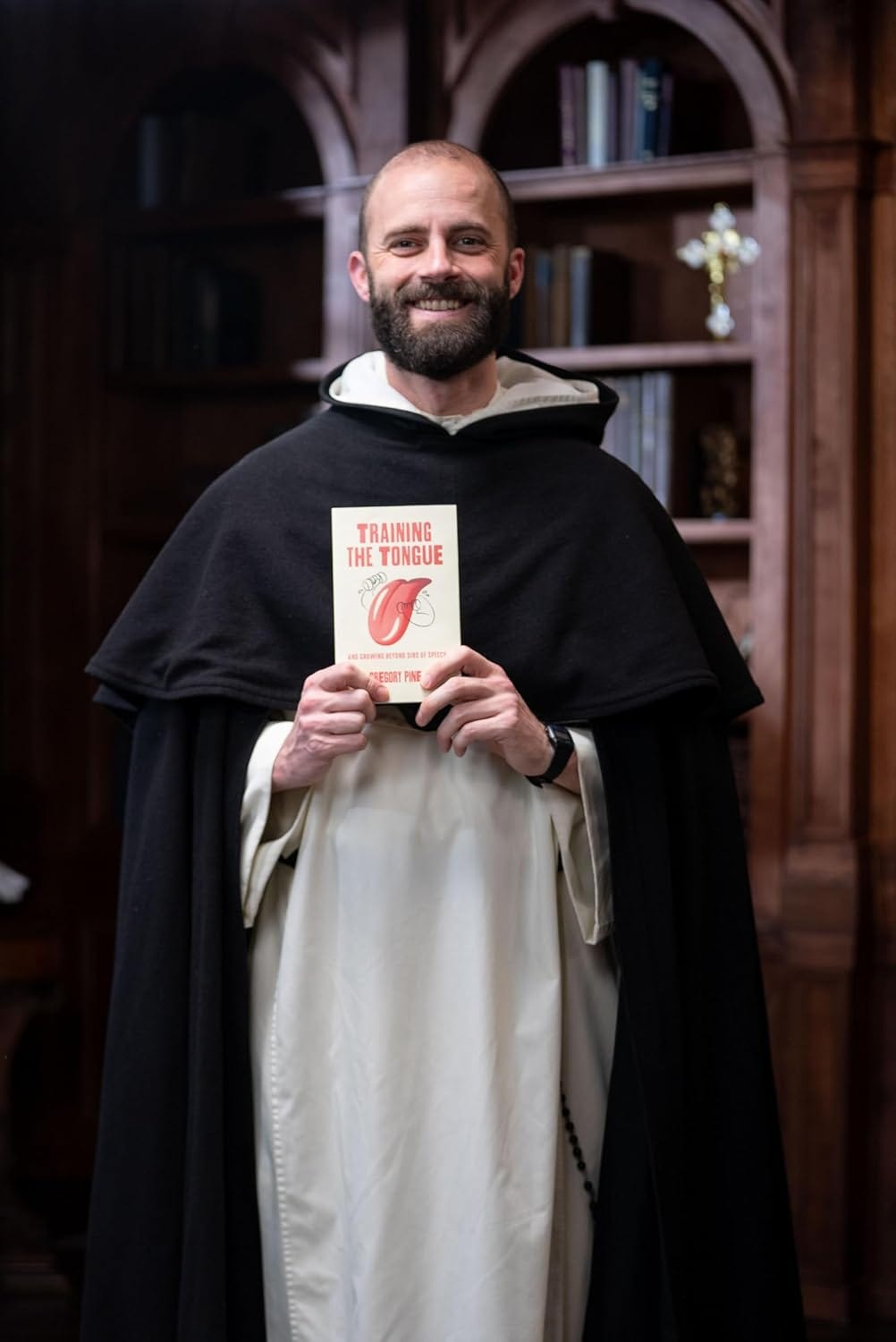
A younger, more atheistic me was allergic to books so opposed to my free speech values written by Dominican friars, but I am almost five years into a meditation practice now, and my recent exploration of Father Thomas Keating’s centering prayer has made me more receptive to what Catholic monks have to say.
So, I bought the book, begrudgingly, because it made me feel something, though I haven’t yet read it (so this isn’t a book review).
I flipped through Father Gregory Pine’s book, the sins at issue seem to be gossip, lying, flattery, crassness, disparagement, mockery, and so forth. He grounds his work in the thought of Saint Thomas Aquinas, as Keating’s work is, and teaches that speech has a purpose, and that purpose is communion. We speak so as to seek truth, share our understanding, voice our conscience. We correct one another in charity, pass on wisdom, and ultimately, if we do it right, lend our tongue to God himself.
He writes that speech must be true, charitable, and ordered toward communion between human and divinity.
Sounds very Buddhist, that friar does.
The third factor on the Buddha’s Noble Eightfold Path is Right Speech, which is framed first as the abstinence from certain kinds of wrong speech: false, malicious, harsh, idle. Fr. Pine might recognize these as some of his sins of speech. The second frame is in the positive: Right Speech is true, concordant, courteous, timely and beneficial.
We forget it now, in a world where Evangelical Christians and fundamentalist Islam have made religiosity in politics distasteful and dangerous, but the Founders believed that the spiritual, even religious, quest for virtue was a pre-condition to the success of our democratic republic. John Adams, famously: “Our Constitution was made only for a moral and religious people. It is wholly inadequate to the government of any other.”
James Madison, who architected America’s First Amendment to its Constitution, wrote in his earliest drafts that “The people shall not be deprived or abridged of their right to speak, to write, or to publish their sentiments.” (Madison used sentiments in the 18th century sense, like Adam Smith used it in his Theory of Moral Sentiments, to mean moral judgments, actively discerning right from wrong, not as we use it today to mean simply opinions or preferences.) Jefferson, too, understood the Free Speech Clause in spiritual terms: “Almighty God hath created the mind free,” he wrote, and that “all men shall be free to profess and by argument to maintain, their opinions in matters of religion.”
The Founders’ logic on the importance of free speech and free souls to the political health of the republic runs like this:
the human mind is, and by right ought to be, completely free in matters of judgement and belief;
to develop sound judgment and right belief, our conscience must be free of coercion;
the freedoms of speech, press, and free inquiry protect the means by which our conscience searches, tests, and refines its judgment;
a republic of free men succeeds only in so far as its citizens develop the capacity of forming and communicating such judgments about their government.
Madison, Adams, and Jefferson of course knew that free speech does not automatically produce virtue, and that a society of free thinkers would necessarily create a lot of untruth as a waste product. But they understood that virtue cannot be authentically embodied if produced by coercion of belief or suppression of inquiry.
But over a century ago, the American right to free speech abandoned as its motivating purpose the conscience or virtue of the individual, and replaced it with a concern for “political truth” and democratic optimization. Free speech had always been a right of speakers, obviously, but thanks to the dominance of a peculiar metaphor, our law now concerns itself primarily with the rights of hearers as consumers of speech.
Justice Neil Gorsuch did us the favor of summarizing the modern ideal of free speech. He writes, in 303 Creative v. Elenis (2023):
The framers designed the Free Speech Clause of the First Amendment to protect the “freedom to think as you will and to speak as you think.” They did so because they saw the freedom of speech “both as an end and as a means.” An end because the freedom to think and speak is among our inalienable human rights. A means because the freedom of thought and speech is “indispensable to the discovery and spread of political truth.” By allowing all views to flourish, the framers understood, we may test and improve our own thinking both as individuals and as a Nation. For all these reasons, “[i]f there is any fixed star in our constitutional constellation,” it is the principle that the government may not interfere with “an uninhibited marketplace of ideas.” (internal citations omitted)
That metaphor—the marketplace of ideas—was popularized in the 1969 case Red Lion Broadcasting v. FCC. “It is the purpose of the First Amendment,” writes Justice Byron White, “to preserve an uninhibited market-place of ideas in which truth will ultimately prevail.” Ironically, the phrase entered constitutional law not as a shield against restrictions on free speech but as a justification for it. In the Red Lion case, a radio preacher in Pennsylvania insulted a journalist by name in a broadcast, and the journalist demanded air time under the FCC’s Fairness Doctrine to respond. The station refused, and the government forced it to comply. Justice White wrote for a unanimous Supreme Court that, because broadcast frequencies are scarce, radio stations who license those frequencies from the government have to comply by its rules, which under the Fairness Doctrine included a ban on one-sided political speech on public airwaves.
The preceding sentence, often omitted when the famous metaphor is recited, makes the point clear: “It is the right of the viewers and listeners, not the right of the broadcasters, which is paramount.” Hearers, not speakers.
Ever since Red Lion, restrictions on speakers are justified if, in the government’s view, it leads to a diversity of viewpoints for the benefit of hearers. Opinions like Gorsuch’s might recite the spiritual ends of the Free Speech Clause, but the past hundred-odd years of First Amendment cases shows that it is the means, and not the ends, that have the force of law.
The problem with the “marketplace of ideas” is that it presumes we engage with knowledge like consumers in a market rather than as seekers of truth. A free market in goods and services does, in fact, deliver the largest diversity of goods at the best quality and the lowest price. A free market in ideas does the same—it gives the people what they want. The metaphor would be a sound one, if what the people wanted was truth.
But they don’t. What they want is utility, whether or not its true. So in our uninhibited marketplace of ideas, in addition to useful truths, we should expect to find a whole lot of useful untruths as well. Which we do, in spades. And so, if the purpose of the First Amendment is to ensure that competitive forces allow “truth to ultimately prevail”, the government can inhibit the gurus who profess untruths (whatever the government defines that to be) under the guise of preserving competition in the “uninhibited marketplace.” They’re just doing what governments do and correcting a market failure, after all.
That’s a big problem. Not only does the “marketplace of ideas” clearly not result in better or truer ideas winning out, the metaphor has since its inception served to justify restrictions on speech in the name of that demonstrably false premise.
So, we might want to tweak the metaphor.
I propose the bizarre bazaar.
Imagine endless rows of stalls, with hawkers of ideas desperately competing for your attention. Every single possible idea is there for you to find. As an idea becomes more useful, more vendors compete to offer the idea, but that doesn’t mean those ideas are more true or that they somehow “win”—ideas have a marginal cost of zero, after all, and their supply is infinite—they just appear in more varieties of expressions, to satisfy consumer demand. The aggregate buying and selling, though interesting, is not the important level to focus on. It’s the individual experiences of every human soul in the bazaar.
There are no new ideas in the bizarre bazaar. They’re all here, they’ve always been here. Like Watts’s gurus, not every stall will have the answers you seek, and some may even lead you astray. But that’s ok, those answers may be for someone else, not for you. Or, it may be that holding onto a wrong idea, or living a false life, is precisely what you need to find your way to truth. The government censors can’t know what is true or not in the sense that matters to your particular journey.
Those censors may have good intentions, no doubt. Their rules may ensure the seekers avoid encounters with wrong ideas, save them from the experience of arguing with charlatans, and spare them the educational indignity of holding a falsehood long enough to recognize it as false. But to regulate away all those market failures is to remove the training by which the seeker becomes a master.
To entertain you with even more metaphors, the difference between the bizarre bazaar and the marketplace of ideas is the difference between a farmers’ market and a commodities trading floor. On the trading floor, no one touches the wheat; the wheat is an abstraction. The goods are fungible, the participants interchangeable, the system is optimized for a single output: the generation of information through the process of price discovery.
The marketplace of ideas treats speech like a commodities floor. Ideas are fungible units. What matters is that the market offers sufficient diversity and that no single supplier corners it. The government’s role is, of course, to regulate the floor—ensure liquidity, punish market manipulation, keep the market “uninhibited” so price discovery can occur. That crucial signal that emerges from the system is all that matters, because it tells us which idea is “best.” The participant is irrelevant, the system is the thing.
The bizarre bazaar is a different marketplace entirely, messy and disorganized and prone to the type of failures that make it human. Every seeker who enters walks a different path, encounters different stalls, and finds themselves making different deals and assembling different baskets of truths and untruths. The seeking is the process, as Watts showed. The haggling with vendors develops in the seeker what Madison meant by conscience, moral discernment, the ability to weigh true value.
That is, I think, why the Buddha emphasized Right Speech, and why Fr. Pine wrote a whole book on the trained tongue. Right Speech is what the wandering produces in the speaker who takes it seriously. It is a practice cultivated from within by a conscience that has been free to search, to err, and to search again. That wandering, that discipline, is only possible within a culture and polity of truly, maximally free speech. Only within freedom do we discover the need to discipline ourself, to self-regulate, if we truly want to find the “best” ideas; regulation from without makes that discovery impossible.
We shouldn’t care if the “best” ideas emerge from the marketplace as a price signal emerges from a trading floor. That’s not how it works. The ideas are already there, they’ve always been there, but they cannot be handed to us, we have to find them for ourselves. What matters is that the bazaar remains open to one and all, sellers in their infinite stalls and buyers wandering between them, looking for God, or at least the parts to assemble Him.
Anyway, the friar’s book is now on my shelf, waiting to be read when I’m a bit further along in my wandering. Maybe I’ll write a review after I climb up and come down from that particular mountain.