
If you enjoy this essay, please share it with someone who might be surprised by the study’s findings. I hope it starts interesting conversations for you.
If you could believe it, not too long ago, Americans used to complain that America was not polarized enough.
The notorious segregationist Governor George Wallace said in 1968 that there was “not a dime’s worth of difference between the two majority parties.” In 2000, consumer advocate and hero to the American left, Ralph Nader, repeated the same line—that there was not a dime’s worth of difference between Bush and Gore. The far left and the far right shared a frustration with their exclusion from American politics as the so-called “uniparty” squabbled over details but broadly agreed on all the major questions.
And they had a point. The parties really were more alike, and it was once common for people to change their party affiliation as their views evolved. Hillary Clinton campaigned for “Mr. Conservative” as a Goldwater Girl in 1964. Strom Thurmond, the most famous of the now-extinct Dixiecrats, switched parties around the same time. Elizabeth Warren was a registered Republican until 1996. And most notoriously, President Ronald Reagan was an FDR booster and union leader before pronouncing that “I didn’t leave the Democratic Party, the Democratic Party left me.” These were not treated as ideological betrayals because party affiliation was not a fixed identity.
As recently as 2010—the midterms of the so-called Tea Party wave—political scientist Alan Abramowitz wrote “Why Political Polarization Might Be Good For America”, arguing that “It’s healthier to have parties that actually stand for something than to have the situation that we had 50 or 40 years ago, when you really didn’t know what the parties stood for because there was so much overlap between them.”
Well, he got his wish. And nobody is happy about it.
So what changed? The story is familiar to every educated American who has paid any attention to politics over the last two decades.
Barack Obama wins the 2008 election, becoming the first African-American President of the United States. This provoked a backlash among white conservatives, those Obama described during the campaign as “bitter” people who “cling to guns or religion or antipathy to people who aren’t like them.” After Obama won again in 2012, the disaffected whites became more bitter, as the Tea Party movement hardened into opposing everything he did. Pundit after pundit confirmed what seemed obvious at the time: a “whitelash,” mirroring Reconstruction-era opposition to Black progress, was repeating itself. Economic frustration and racial grievance culminated in a worry that America has changed for the worse, “triggered by Obama’s election.” When Trump descended the golden escalator in 2015, he tapped directly into that reactionary fear, further radicalizing the right-wing, sending them into a negative feedback loop for the past decade, making the right ever more extreme, shocking decent people into protest and resistance.
This story was most memorably articulated in Ta-Nehisi Coates’s 2017 essay, “The First White President.” For Coates, Trump’s entire political existence can be explained as a negation of his Black predecessor. Economic anxiety alone couldn’t explain it, because Trump’s voters were more affluent than Clinton’s. Policy positions alone couldn’t explain it, because Trump had no coherent ideology. What remained was racial grievance. “Trump moved racism from the euphemism and plausible deniability of ‘dog-whistle’ politics to the overt and explicit.” The birther conspiracy. The Mexican “rapists” crossing the border. The “shithole countries” robbing Americans blind. These were signals to a white electorate that someone was finally saying what they were all thinking.
Adam Serwer extended the analysis in his piece, “The Cruelty Is the Point.” He argued that the defining characteristic of Trump, as compared to the kinder, but defeated, GOP nominees like McCain and Romney, was that his coalition was united not by any positive program but by a shared desire to punish outgroups. The laughter at rallies when Trump mocked a disabled reporter, the chants of “send her back,” the family separations at the border—these weren’t means to an end but ends in themselves, rituals of communal bonding through cruelty.
In the award-winning 2013 book, “Change They Can’t Believe In,” the authors traced a direct lineage from the Know-Nothing Party through the Ku Klux Klan to the John Birch Society to the Tea Party to MAGA, each a reactionary spasm triggered by perceived threats to white Protestant dominance. By the time Trump took office, the academic consensus and the journalistic consensus had converged: the American right had radicalized around racial grievance, lurching ever further to the extreme right as centrists and leftists stood still.
It’s a familiar, coherent story. It explains the vitriol, the norm violations, the sense that something broke.
There’s only one problem: when researchers actually measured what Americans believe—not how they feel about the other party, not what their party identification is or which candidate they support, but their positions on actual policy issues over time—they found something else entirely.
In a study published just a few days ago, on February 4, 2026, scientists in Cambridge University’s Political Psychology Lab used a novel approach to measure political polarization. Using a machine-learning technique that clustered Americans by their actual positions on issues rather than party affiliation or self-reported ideology, they found a 64% increase in polarization among Americans between 1988 and 2024, with almost all of that increase occurring after 2008. Interestingly, polarization over the 1990s and 2000s was essentially flat (validating the “uniparty” frame).
Their most provocative finding? The average policy preferences of the American Right have remained remarkably consistent since 1988, becoming only 2.8% more conservative over the past ~40 years. In contrast, the American Left has become 31.5% more progressive over those same decades.
The polarization of the American electorate, in other words, is driven almost entirely by progressives moving significantly further to the left.
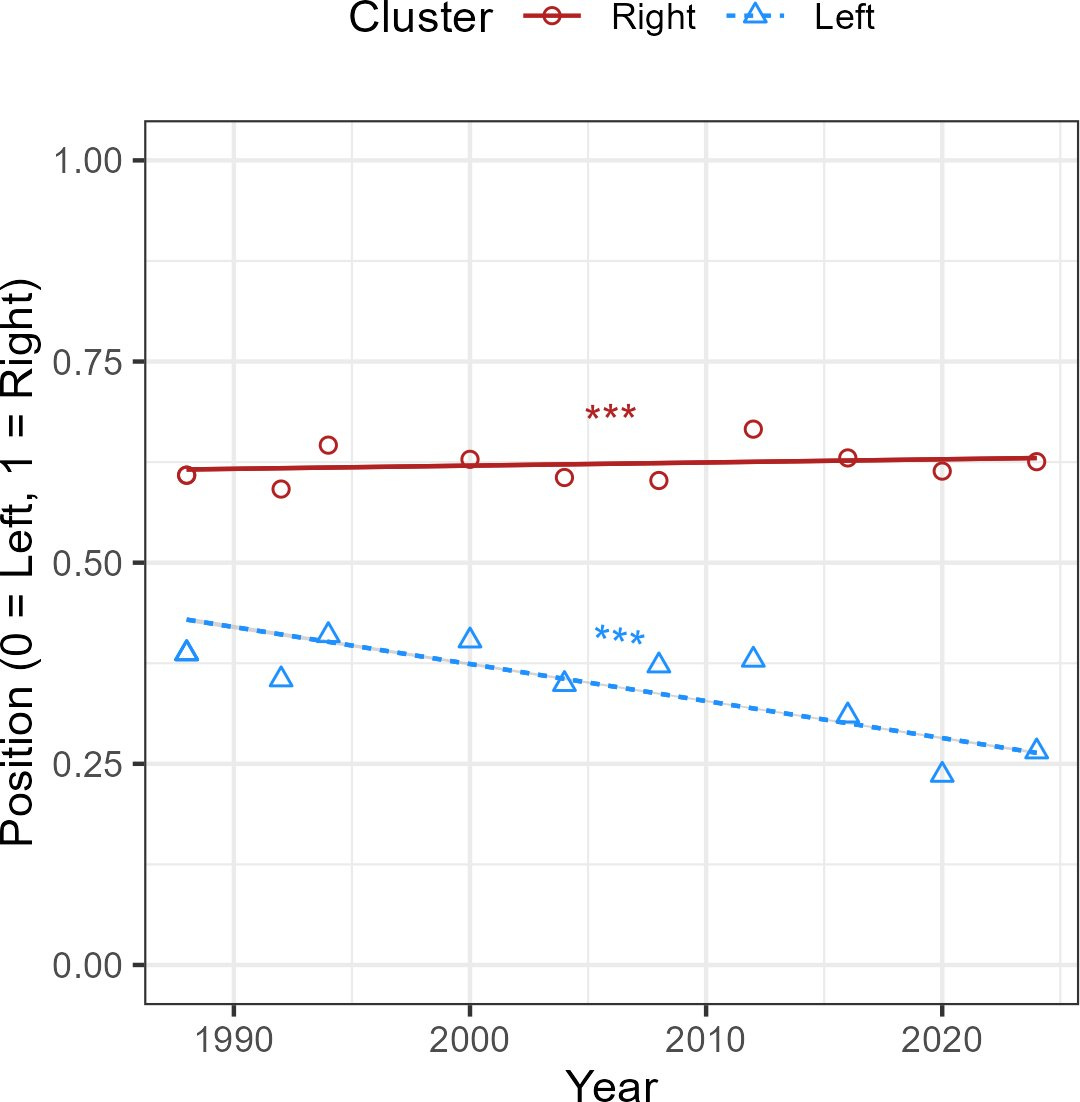
This holds across issues, though the pattern varies: on issues like abortion and traditionalism, the clusters have moved in opposite directions, but on issues like equal opportunities, both groups shifted left—though the progressive group moved much faster, stretching the distance between them.
To measure this, the scientists used a new measurement technique for issue polarization, as distinct from affective polarization (the delta between positive affect for one party and negative for the other) or perceived polarization (exactly what it sounds like—the polarization we subjectively perceive). They used a machine learning algorithm typically applied in fields like computational psychiatry called k-means clustering to divide survey respondents into two groups based on their actual policy positions across multiple dimensions simultaneously. This approach doesn’t rely on party identification, self-reported ideology, or single issues—each of which can be tainted by any number of confounding factors. Instead, k-means clustering allows us to divide the American electorate into the two most internally coherent, externally distinct clusters across multiple issues—the Left and the Right.
They then measured polarization along three dimensions: separation (distance between cluster centers), cohesion (internal agreement within each cluster), and size parity (whether the clusters are roughly equal, which intensifies political conflict). This led them to find a significant increase in “sorting”, the alignment of issues with partisan identification. By 2024, 20% more people in the Left cluster identified as Democrats and 51% more identified as liberals than in 1988; similarly, 30% more people on the Right identified as Republicans and 39% more as conservatives. The scientists point out that cross-cutting views have become much rarer, meaning there are far fewer “real” centrists who hold Left positions on some issues and Right on others.
This study confirms earlier findings that were criticized because of methodological problems the Cambridge study was designed to correct. Pew Research Center’s landmark 2014 study of political polarization tracked ideological consistency rather than position—it could tell you that Democrats were becoming more uniformly liberal, but not necessarily that they had moved further from center. The Cambridge study, by clustering Americans based on actual policy positions rather than party identification or self-reported ideology, addresses that limitation directly: it measures where people stand, not how neatly their views align with a party label.
Separately, an analysis in the FT pulling on data from the U.S. General Social Survey documented a related phenomenon. Drawing on research by political economist Laurenz Guenther, Burn-Murdoch showed that while voters and mainstream politicians remain broadly aligned on economic questions like taxation and public spending, a widening “representation gap” has opened on sociocultural issues—immigration, criminal justice, cultural integration—where the voting publics have long favored greater emphasis on order and control, while their political class has tilted toward more permissive and inclusive approaches. The populist right, in country after country, has expanded into that gap. The American version of this story maps onto the Cambridge data: the leftward shift is concentrated on cultural and social issues, and the political space vacated by that shift is where Trump’s coalition now lives.
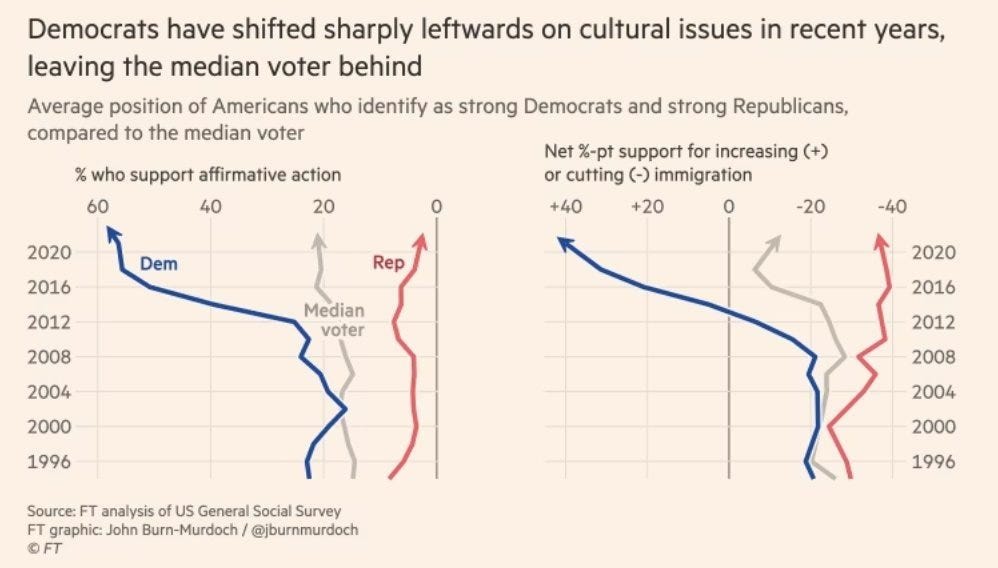
Multiple methods, same results: the Left became more, much more, progressive and leftist, while the Right largely stood still.
(Immigration is the most vivid illustration (and the one we will explore the most below) but the Cambridge data shows the same asymmetric pattern across issues — from criminal justice to abortion and sexual rights to entitlement reform to the role of government.)
One of the Cambridge researchers speculates: “Part of the recent success of the US right may be their ability to tap into outgroup animosity for a perceived ‘woke’ left, rather than a firm belief in some of the more extreme right-wing positions adopted by the Republican leadership.” This rhymes with the accepted narrative—that MAGA is motivated not by any positive, coherent policy program, but by outgroup hatred—except it’s not a “whitelash”, it’s a backlash against progressive or “woke” excesses.
The obvious next question is: if the Left became more ideologically pure, and people with cross-cutting views disappeared, then where did those people in the center go? We know that, as of 1984 and 1988, both parties competed for the center, and Democrats used to vote for Republicans in droves, as when Reagan won 49 states in ‘84 and George H.W. Bush won 40 in ‘88. It’s impossible to imagine such landslides in today’s polarized environment, where elections are decided by a shrinking number of swing states.
One theory relies on the fact that those in the Left cluster see Trump’s GOP as full of hypocrites, taking contradictory policy stances that make no sense. That theory holds that the center migrated into the GOP, and that is why they seem so self-contradictory. As the Left became more pure and tightened its control over the Democratic Party, the only place for everyone excluded was in the other party. The Democratic Party’s leftward migration on cultural issues created a negative space, and that space filled with everyone who found themselves on the wrong side of the new progressive consensus.
Look at the composition of the current GOP and you find an alliance of outcasts that makes no sense on a traditional left-right spectrum: libertarians who want the government out of the bedroom and the boardroom; populists who want tariffs, industrial policy, and entitlement expansion; religious conservatives focused on abortion and marriage; tech executives who voted for Obama twice; union members whose fathers voted for FDR. Peter Thiel and the Teamsters. Elon Musk and rural evangelicals. RFK Jr. and the remaining country-club Republicans. What unites them is not a shared ideology—they disagree on economics, foreign policy, and the role of government.
What unites them is what they’re against: a progressive cultural project they find alien, censorious, and increasingly hostile to their values or interests.
A fascinating study from 2024 supports this theory, and corroborates the Cambridge study’s findings on sorting as well. It found something many of us sense intuitively: that individual attitudes on hot-button issues form two structurally distinct networks that map cleanly onto partisan identity (i.e., knowing someone's position on one issue (say, gun control) lets you predict their position on seemingly unrelated issues (say, climate change)). It’s the shape of those clusters that jumps out:
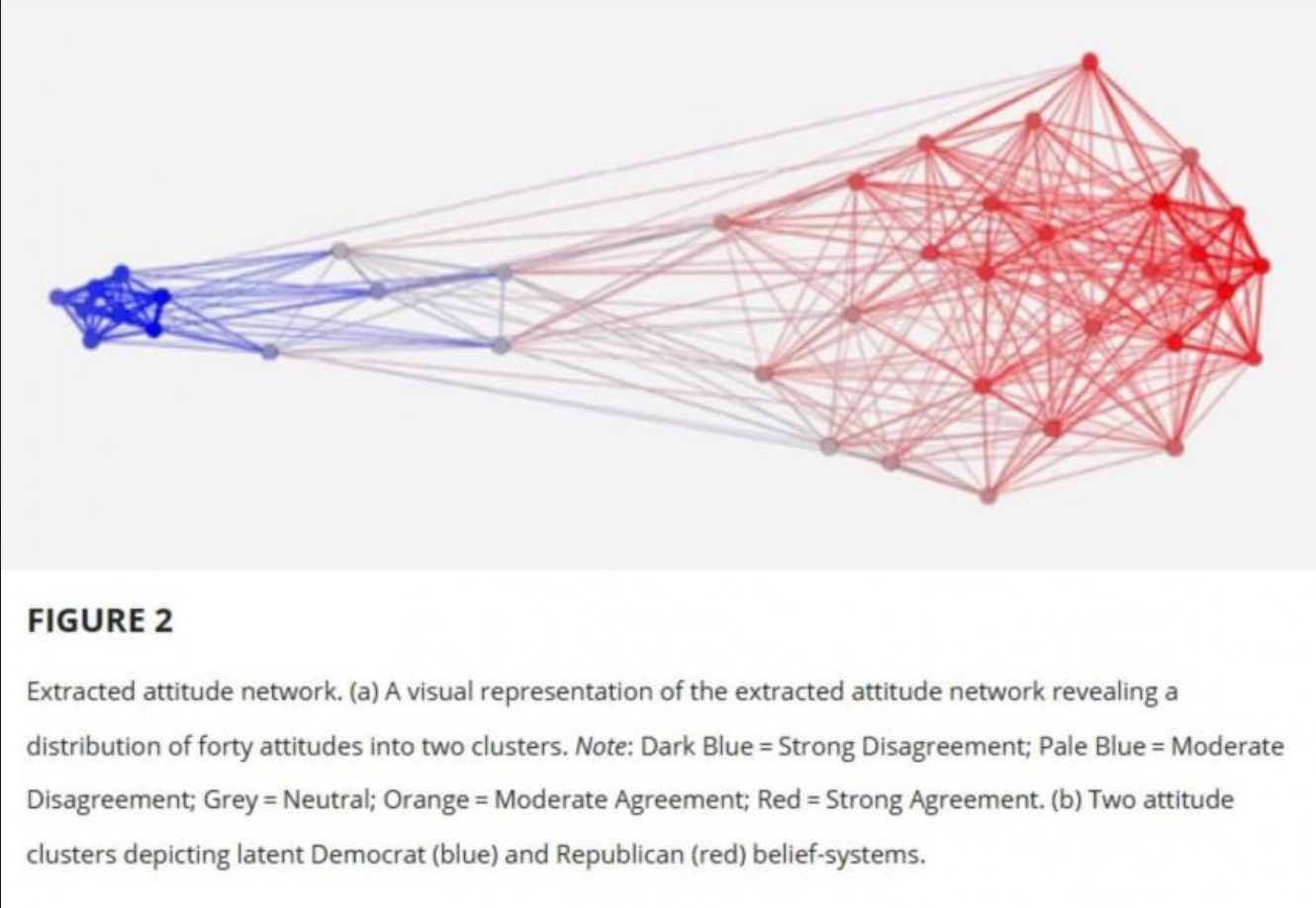
The shape of these clusters strongly suggests that the centrist cross-cutters are now in the Republican tent. This theory makes sense with what we see happening, in no small part because Trump’s coalition includes many disaffected Democrats.
In 2008, Donald Trump himself was a prolific Democratic donor, giving money to Hillary Clinton, Chuck Schumer, even Kamala Harris. Elon Musk voted for Obama twice and still supported Dems until 2022. Tulsi Gabbard was once the vice chair of the Democratic National Committee. RFK Jr. is, obviously, a Kennedy. All are now prominent figures in a Republican White House. The standard narrative is that they radicalized rightward, but it may be that the ground moved under their feet.
In contrast, the neoconservative movement that brought the Bush-Cheney ticket to power lost control of their party to this bunch of centrist former Democrats. They now call themselves Never Trumpers and are politically exiled. Conservatives who stayed in Trump’s GOP are often brought to heel and are forced to moderate—consider how Trump locked Republican delegates in a room and took their phones, and would not let them out until they approved a party platform that removed anti-LGBTQ language and any reference to a federal abortion ban, angering many conservative allies.
So, what do we make of this? It’s clear that the racial backlash thesis isn’t wrong—it describes something very real about rhetoric, behavior, and norm violations (and this analysis says nothing about concerns over democratic backsliding)—but it doesn’t explain the diversity of the current Republican coalition, because it doesn’t describe issue positions. A president who executes Clinton’s immigration policy goals by expanding Obama’s immigration enforcement programs is doing something different than his predecessors when he does it with cruelty and spectacle. Rhetoric matters—it shapes who feels safe, who feels targeted, and what becomes politically thinkable next.
Intentionally hostile rhetoric feels like a policy shift, even when the underlying policy hasn’t changed, even when the personnel in charge haven’t changed (remember, Border Czar Tom Homan was awarded by President Obama for his service in 2015). Clinton's bureaucratic tough talk is positively meek compared to Trump's bellicosity. But Trump's rhetorical escalation didn't happen in a vacuum. It is in part a deliberate enforcement strategy to deter border crossings and encourage self-deportation, as hawks openly argue, and a self-conscious corrective against Biden-era policies that departed from prior Democratic administrations in a major way.
Obama himself, in a 2010 speech, warned against the permissive approach his party would later adopt under Biden—easy legal status for illegal immigrants through a mobile app, robust funding for social services for migrants, and removal of border fences—and predicted the consequences:
“There are those in the immigrants’ rights community who have argued passionately that we should simply provide those who are [here] illegally with legal status, or at least ignore the laws on the books and put an end to deportation until we have better laws. …
I recognize the sense of compassion that drives this argument, but I believe such an indiscriminate approach would be both unwise and unfair. It would suggest to those thinking about coming here illegally that there will be no repercussions for such a decision. And this could lead to a surge in more illegal immigration. …
And no matter how decent they are, no matter their reasons, the 11 million who broke these laws should be held accountable.”
Trump’s rhetoric is a direct response to a Democratic Party that moved from Clinton's “we cannot tolerate illegal immigration” to a base that chants “no human is illegal on stolen land.” That's not a justification; it's a description of the dynamic. Consider what it means that Bill Clinton’s own positions on immigration and crime now sound Trumpian. When the Left shifted, positions that were once centrist began to register as extreme. Trump’s actual cruelty is real and shouldn’t be dismissed, but the perception that his policies represent a radical departure is itself a product of the asymmetric polarization the data reveals.
The Right did radicalize, but not in pursuit of an extreme ideology of its own. It radicalized in reaction to the Left’s rapid, asymmetric movement away from the center.
What we lack is a clear answer as to why the left polarized so much compared to the right, but we know it predated Trump. Obama famously clashed with the growing progressive/socialist flank of the Democratic Party for his entire presidency. The 2016 challenge of Berne Sanders to Obama’s anointed successor, Hillary Clinton, did not come out of nowhere. Sanders is a self-identified socialist, and polls have shown that, since 2012, a majority of Democrats have a favorable view of socialism (51% in 2012, climbing to 66% today). That all reflects a profound leftward shift that began before Trump arrived on the scene.
There are a few interesting theories as to why this happened. One comes from Ezra Klein’s former co-founder at Vox, Matthew Yglesias, who coined “The Great Awokening” in 2019. Yglesias argues that white liberals underwent a rapid, top-down shift on racial attitudes starting around 2012, driven not by their own voters but by elite signaling and social media dynamics—a shift that moved the Democratic Party’s cultural center of gravity faster than its base could follow.
Political scientist Yascha Mounk traces the intellectual genealogy in “The Identity Trap”, arguing that the modern progressive social agenda—post-colonialism, critical race theory, intersectionality—was incubated in academic departments, taught to a generation of Millennials not as theory but as fact, and then escaped containment when they graduated and became politically active. The new progressivism replaced the older universalist liberalism that had defined the center-left since the Civil Rights era. Journalist Wesley Yang calls the result “the Successor Ideology” and focuses on the mechanism of its spread—how a set of academic commitments became the operating system of universities, newsrooms, HR departments, and nonprofits with startling speed, such that dissent from the new consensus became professionally risky.
Democratic strategist Ruy Teixeira in his book “Where Have All the Democrats Gone?” makes the electoral case with polling data: the party’s leftward shift on immigration, crime, race, and gender alienated precisely the working-class voters who ended up in Trump’s coalition.
There are other arguments, too, but nothing as cohesive and accepted as the familiar story of the right’s radicalization—a story that rings true with respect to the crass, hostile rhetoric and political style of MAGA, but is contradicted by data on actual policy positions.
But perhaps that makes sense. The modern Left is, after all, defined by its ideological coherence and built around its shared narratives. And the modern Right is defined simply as “not Left.” That asymmetry—one side defined by what it believes, the other by what it rejects—may be the deepest source of mutual incomprehension in American politics. The Left looks at the Right and sees incoherence, because no single ideology unites the coalition. The Right looks at the Left and sees intolerance, because the coalition demands conformity on an ever-expanding set of cultural commitments. Both perceptions contain truth. But neither side can fix what it can’t accurately describe, and right now the dominant description—that the Right radicalized while the Left stood still—is the opposite of what the evidence shows. A better politics starts with a better diagnosis.
The uncomfortable implication is this: if the Left is the side that moved, then the Left is the side that has to reckon with what it left behind. That doesn’t absolve Trump of his cruelty, or his coalition of its worst impulses. But it does mean that the path back to a functional, de-polarized politics must begin within the Democratic Party. The evidence suggests that the voters it lost didn’t become right-wing. They became homeless, and someone came along and offered them a roof.
It thought this was going to be a good piece but it’s not.
There was no WHITELASH against Obama for being the “first af American prez” there was a backlash against his socialist policies that were different than how he ran his campaign. The only honest moment in his campaign was Joe the Plumber.
The backlash was economic.
It’s always been economic. MAGA, the Tea Party, Bernie Bros ITS ALL ECONOMIC